Tuesday, June 30, 2015

FINLAND IN WWII


Finns. Talvisota, Jatkosota & Lapisota, three wars during WW2.


Finnish, German, and Soviet troops at the start of the Continuation War in June/July 1941. The Germans began their assault on 29 June from Petsamo area, and the Finns attacked on 1 July from Suomussalmi and Kuusamo area.


In the interwar period Finland maintained an uneasy neutrality. In 1939-1940 it fought the defensive Finnish-Soviet War (1939-1940). Its territorial losses as a result of that conflict were an outcome foreordained by the demographic reality that just 4 million Finns faced a population of 171 million in the pre-1941 Soviet Union, and that the Red Army was the largest armed force in the world. Finland did not have German support while fighting the Soviets in 1939. Adolf Hitler began to view Finland differently as he prepared to launch Operation BARBAROSSA, starting as early as July 1940. 

German arms were delivered to the Finns, transit agreements were signed permitting German troops to move across Finnish territory to and from conquered Norway, and full military staff conversations began in December. Moscow did not know the full extent of Finish-German military coordination, but even its fear of Germany's unabated appetite for ever more territory was finally aroused. Hitler's creeping influence in a country that Joseph Stalin viewed as within his sphere of influence, as previously agreed between Moscow and Berlin, raised anger and fear in the Kremlin. The question of which Great Power would exercise ultimate hegemony over Finland thus became a critical diplomatic issue in the year between the fall of France in June 1940 and the Axis invasion of the Soviet Union in June 1941. Finland joined the Axis attack on the Soviet Union after a strictly operational delay of a few days, but Finland was never a full Axis state in spirit or intent. For the Finns, resumption of active hostilities with the Soviet Union was solely an effort to reverse their loss of 1940, a strictly limited war aim reflected in their term for the conflict: "Continuation War." 

The Finnish Army of 1941 was greatly expanded from its dispositions of 1939: it fielded 16 excellent divisions equipped with modern German weapons. Wehrmacht land, air, and naval forces took up attack positions in northern Finland in April-June, 1941. Preparatory to BARBAROSSA, four German divisions were allowed into Lapland to open a high Arctic front. On the opening day of the campaign, June 22, the Finnish Navy occupied the Aland Islands without interference by the Soviet Navy. German troops also attacked out of Lapland toward Murmansk and the Kola Peninsula. Finnish troops opened a southern front in Karelia a few days later. Once the Finns reached their old 1939 boundary they stopped, encouraged to do so by heavy pressure from the United States, but not before Great Britain declared war on Finland in solidarity with the Soviet Union. In that desperate hour for London, any enemy of Hitler was Britain's ally, and any ally of Germany was necessarily Britain's enemy. The Finns did not advance farther during the rest of the war. Trying to take Leningrad and Moscow were German, not Finnish, war aims. Even so, the effort to recover lost territory by swimming with the turn of the geopolitical tide in 1941 engaged the Finns in a long war on what became the northernmost section of the Eastern Front: fighting against the Red Army lasted from June 1941 to September 1944, with more limited fighting against the Germans after that. 

Over the course of the naval war, the Finnish Navy lost one monitor, six minesweepers, and 50 merchantmen and coastal patrol ships. Finland lost far more men in land combat, as Hitler's BARBAROSSA operation failed by the end of November 1941. The Red Army counterattacked in the Moscow offensive operation (December 5, 1941-January 7, 1942) and the Rzhev-Viazma strategic operation (January 8-April 20, 1942). The Finnish front thereafter stretched from German positions outside Leningrad, across southern Karelia and along the forest zone of the eastern frontier, to a distant fight by mainly German troops in the high Arctic Circle. The Finns again held back from advancing toward Leningrad, but their presence in southern Karelia completed a three-sided German lock on that starving city throughout the 900-day siege of Leningrad. The Finns also placed restrictions on permitted Wehrmacht operations in their high Arctic territory, including during Operation LACHSFANG. By the end of 1942 the Finns were in the increasingly difficult position of waiting to see which of their vastly more powerful neighbors would win the war along the Eastern Front. They were also influenced by pressure from Washington not to exceed recovery of their national territory, on pain of incurring American displeasure or even a declaration of war to match Britain's. 

Germany was clearly losing the war at the start of 1943, a fact brought home to the Finns by German defeats at El Alamein and Stalingrad. The Finns opened secret talks with Moscow in an effort to withdraw from the war by negotiating a limited frontier settlement. But Moscow and Helsinki could not agree on where to draw the border in Karelia, the mutual casus belli in 1939 and again in 1941. The Red Army went over to the permanent offensive all along the Eastern Front in the late summer of 1943, following another great victory at Kursk and follow-on counteroffensives in the north and in Ukraine. Finnish-Soviet talks broke down in February 1944, even as German Army Group North was pushed back from Leningrad to the Panther Line section of the Ostwall. The Red Army attacked the main Finnish position on the Mannerheim Line on June 10, 1944, achieving complete operational surprise. Soviet tanks and mobile infantry broke through the next day. The Finns now discovered how greatly improved in combat performance the Red Army was since the winter of 1939-1940. Soviet forces were far superior in weapons, veteran troops, and proven commanders. General Leonid A. Govorov's Karelian Front took Vyborg within two weeks, a triumph for which he was promoted to "Marshal of the Soviet Union." The Stavka launched the second phase of the "Svir-Petrozavodsk operation," a full-scale invasion of lower Finland, through the southern forests on June 21. At first, Hitler sent German reinforcements to Finland in exchange for agreement that Helsinki would not accept a separate peace with Moscow. But the combat pressure from Karelian Front was relentless, while the Germans were themselves knocked backward 300 miles by the stunning Soviet achievement of Operation BAGRATION in Belorussia. That marked the start of a cascading series of Soviet victories and catastrophic German defeats in the center of the Eastern Front, which left the more northern German and Finnish flank hanging. 

Compared to its performance in Finland in 1939-1940, the Red Army's second campaign in Karelia was a superior example of combined arms warfare, or Blitzkrieg. Yet, Moscow did not pursue total war against Finland the way it did against all other Axis states. Stalin was prepared to offer terms to the Finns partly in response to intervention by President Franklin D. Roosevelt and the wider issues of alliance politics that might be adversely affected. Nevertheless, events on the ground had a life of their own. Elements of the powerful Karelian Front crossed the Svir River, forcing the Finnish Army back under great pressure. The Soviets took the provincial capital of Petrozavodsk on June 28. Other Red Army Fronts simultaneously attacked in central and northern Finland, at Salla and Petsamo, where they battered German 20th Mountain Army. That isolated 200,000 Axis troops, left guarding a peripheral position by Hitler, while the center and south of the entire Eastern Front were collapsing for want of men. By August 9, the Red Army achieved all goals set by the Stavka for the summer campaign in the north. Events outside Finland also conduced to lessened Soviet operations. German resistance in Estonia and Latvia collapsed during late July, in tandem with a general military crisis for the Germans attendant on the devastation of Army Group Center in BAGRATION. That defeat signaled to Helsinki that it needed to get out of the war before Finland, too, was wholly overrun. 

Mannerheim was brought back to the presidency on August 4, tasked to negotiate an exit from the war. On August 24 the cabinet agreed to seek a ceasefire and armistice with Moscow. Soviet troops stopped advancing five days later. On September 2 the Finns formally severed alliance ties to Germany. A ceasefire was agreed with the Soviets three days after that. Retreating Germans tried to seize the critical Finnish island of Suursaan (or Hogland) in the Gulf of Finland. The attempt was beaten off by Soviets and Finns fighting in tandem against the Germans for the first time. 

Finland signed a formal armistice with Moscow on September 19, 1944. The agreement restored the expanded Soviet border of 1940, confirming that Finland had lost the "Continuation War" as well as the earlier Finnish-Soviet War. Helsinki surrendered rights to a Soviet naval base at Petsamo and to a Red Army and VVS air base outside Helsinki. The key to the armistice was that it required Finland to declare war on Germany and the Finnish Army to actively expel all Wehrmacht and SS troops from the country. But Finnish soldiers proved lax about enforcing that clause against men who were comrades-in-arms just days earlier. Instead, the Finnish Army simply watched German troops flee the country. In some cases, the Finns peacefully escorted rather than harried German troops on their way out during the Wehrmacht's BIRKE withdrawal operation (September 3-29, 1944). There was only one serious armed clash during September between Finnish and German troops. More serious clashes between Finns and Germans marked the later Lapland War, fought during the winter of 1944-1945 with the last German troops in the high Arctic. Under great Soviet pressure, Finland formally declared war on Germany on March 3, 1945. The last German troops left the high north a month later.

American support for Finland's independence helped prevent its incorporation into the Soviet Union as another lost tsarist province and kept it outside the quickly forming bloc of Soviet client states. In 1947 a formal peace treaty was signed between Finland and those Allied states with which it had been formally at war. Helsinki permanently surrendered its disputed Karelian territory to the Soviet Union. It was thereafter compelled to adopt the Soviet foreign policy line throughout the Cold War, but it was not forced to host Soviet armed forces beyond a single base at Porkkala. That base was later exchanged for a Soviet lease on Hangö, which was in turn given up by Moscow in 1955. Unlike Czechs, Poles, or Rumanians, the Finns did not have to adopt Soviet domestic policies and were never ruled by a puppet Communist Party. Similar Cold War arrangements in which foreign policy obeisance to a Great Power was combined with domestic independence became known internationally as "Finlandization."

LINK
LINK

Skanderbeg SS


Members of the Nazi Skanderbeg SS Division with an Albanian Ushtar or gendarme.


The historical and political precedents for the creation of a greater Sqiperia or Greater Albania was set during World War II when the Kosovo and Metohija regions along with territory Southwest of lake Skutari from Montenegro and the western region of Southern Serbia, or Juzna Srbija (now part of Macedonija), were annexed to Albania by the Axis powers led by Fascist Italy and Nazi Germany, under a plan devised by Benito Mussolini and Adolf Hitler to dismember and to destroy the Serbian Nation and people, which the Germans and Italians perceived as the main threat to the axis powers and to the Third Reich in the Balkan.

On April 7, 1939, Italian troops invaded and occupied Albania forcing the Albanian ruler King Zog I Ahmed Bey Zogu, to flee to Greece. Italy formally annexed into the Kingdom of Italy under the Italian king Victor Immanuel and established a military government and viceroy. The Italian began a program to colonize the country when thousands of settlers emigrated to Albania. An Albanian Fascist Party was established with Albanian Black skirts based on Italian models. The Albanian Army consisted of three infantry brigades of 12 000 men.

On October 28 1940, Italy invaded Greece from Albania with 10 Italian divisions and the Albanian Army but were driven back.

Germany sought to assist the Italian-Albanian offensive by operation Alpine Violet, a plan to move a corps of tree German mountain divisions to Albania by air and sea. Instead German built up a heavy concentration of the German Twelfth Army on the northwest Greek Border with Bulgaria, from where the German invasion was launched.

On April 6, 1941, Nazi Germany and the axis powers invaded Yugoslavia, Operation Punishment, and Greece forcing the capitulation of Yugoslavia on the 17th, and Greece on the 23rd. Yugoslavia was subsequently occupied and dismembered. The Axis powers established a greater Albania or greater Shqiperia at the expense of Serbia and Montenegro. Territory from Montenegro was annexed to Greater Albania. From Serbia, the Kosovo and Metohija were ceded to greater Albania, along with the western part of Southern Serbia (Juzna Srbija), now part of Macedonia, an area which was part of Stara Srbija (Ancient Old Serbia). This Kosovo-metohija region and the surrounding territory annexed to Greater Albania was called "New Albania".

To create an ethnically pure Shqiptar Kosovo, which Albanian called "Kosova", the Shqiptari (Albanians) launched a widescale campaigns of ethnic cleansing and genocide. Ethnic Serbs in the Kosovo-Metohija regions were massacred, and their homes were burned, and survivors were brutally driven out and expelled in policy of ethnic cleansing and genocide.

The Balli Kombetar (BK or National Union) was an Albanian nationalist group led by Midhat Fresheri and Ali Klissura whose political objective was to in incorporate Kosovo-Metohija into a Greater Albania and to ethnically cleanse the region of Orthodox Serbs

The Abanian Committee of Kosovo organized massive campaigns of ethnic cleansing and genocide against the Orthodox Serbian inhabitants of Kosovo- Metohuja. A contemporary report described the ethnic cleansing and genocide of Serbs as follows:

Armed with material supplied by the Italians, the Albanians hurled themselves against helpless settlers in their homes and villages. According to the most reliable sources, the Albanian burned many Serbian settlements, killing some of the people and driving out others who escaped to the mountains. At present other Serbian settlement are being attacked and the property of individuals and of communities is either being confiscated or destroyed. It is not possible to ascertain at the present time the exact number of victims of those atrocities, but it may be estimated that at least between 30.000 and 40.000 perished.

Bedri Pejani, the Muslim leader of the Albanian National committee, called for the extermination of Ortodox Serbian Cristians in Kosovo Metohija and for a union of a Greater Albania with Bosnia and Herzegovina and the Rashka (Sandzak) region of Serbia, into a great Islamic state. The grand Mufti of Jerusalem, Haj Amin El Husseini was presented to Pejani a plan which he approved as a being in the interest of Islam. The Germans however rejected the plan.

On September 3, 1943, Italy capitulated by signing an armistice with the Allies. The German were now forced to occupy Albania with the collapse of the Italian forces. The Germans sent the 100th Jaeger Division from Greece and the 297th Infantry Division from Serbia and the German 1st Mountain Division to occupy Albania. These troops were organized into the XXI Mountain Corps which was under the command of General Paul Bader.

Additional security forces for the interior were needed, however, to free up Germans troops for defense of the coastline. The decision was made to form an Albanian SS mountain division for this purpose. In April in 1944, recruitment for the Albanian SS division began under direction of the newly formed Albanian Nazi party, which has been formed through the efforts of Ernst Kaltenbrunner. Acting upon instructions of Reichsfuehrer SS Henrich Himmler, the SS main office ordered the formation of an Albanian volunteer mountain division on April 17, 1944. SS Brigadefuehrern and Generalmajor of the Waffen SS Josef Fitzhum, who Headed the Higher SS and Police Command in Albania, oversaw the forming and training of the division.

The SS high Command planed to create a mountain division of 10.000 men. The Higher SS and Police Command in Albania, in conduction with the Albanian National Committee, listed 11.398 possible recruits for the Waffen SS mountain division. Most of these recruits were "kossovars", shqiptar Ghegs from Kosovo Metohija in Serbia. The Shqiptar Tosks were found mainly in southern Albania. Most of the Shqiptar collaborators with the Nazi forces were the Nazi forces were the so-called Kossovars, ethnic Shqiptars from the Kosmet of Serbia. The Nazi German-sponsored Albanian gendarmes, special police and para-military units were made up by Kossovars. The Kossovars were under the direct control of the Albanian Interior Minister Xhafer Deva.

The Skanderbeg Division was formed and trained in Kosovo and was made up mostly of muslim Shqiptar Kossovars. There were only a small number of Albanians from Albania proper in the division. The Skanderbeg Mountain Division of the Waffen SS was thus essentially a Kosovo or Kosmet Division. The Division was stationed and operated in Kosovo and other Serbian regions almost exclusively.

Of the 11.398 recruits listed for the Division, 9.275 were ascertained to be suitable to draft in the Waffen SS. Of those suitable to be drafted, 6.491 Albanian were chosen and inducted into the Skanderbeg Division. To this Albanian core were added veteran German troops primarily Reichdeutsche from Austria and Volkdeutcshe officers, NCOs, and enlisted men, transferred from the 7th SS Mountain Division "Prinz Eugen" which was stationed in Bosnia-Hercegovina. The Kosovo Albanian 21st Waffen Gebirgs Division der SS "Skanderbeg" consisted in total of 8.500 - 9.000 men of all ranks. The 6.491 Shqiptar recruits were assembled at depots in Kosovo where the formation and the training of the division began.

The official designation for the division was 21 Waffen Gebirgs Division der SS "Skanderbeg" (Albanische Nr 1). The SS Main Office designed a distinctive arm patch for the division, consisting of a black double-headed eagle on a red background, the national symbol of Albania. The word "Skanderbeg", embroidered in white, appeared above the eagle and was warn on the left sleeve. The right collar patch consisted of a helmet with a goat's head on top, the helmet supposedly worn by George Kastrioti Skanderbeg, after whom the division was named. The Shqiptars recruits in the division wore a white skullcap, the national attire of the Shqiptar Ghegs. The SS main office also issued gray skullcaps with the Totenkopf (death's head) insignia sewn on the front below the Hoheitszeichen (the national symbol of Nazi Germany, consisting of a white eagle over a Nazi swastika).

Division was named after George Kastrioti, or Gjergj Kastriota, also as Kastriotis (1405-1468), national hero of Albania, who fought for the Ottoman Turks. As a child, Kastrioti was given as a hostage to Sultan Murat II to be brought as a Muslim at Adrianople (Edrine). Kastrioti became an officer in the Ottoman Turkish army and led the Turkish forces in many victories over Christian troops. Murat II was impressed with his valor and bravery in his battle for Islam and gave him the name Iskander Bey in Turkish, from "Iskander", Aleksander the Great, or prince Aleksander, and "bey", master. The name was shortened to Skanderbeg, beg being the local variant of bey. Later Kastrioti renounced Islam and converted to Christianity and attacked his former Ottoman Turkish masters. He captured the Albanian capital Kroja from the Turkish governor and proclaimed a revolt against the Turks in 1442. Sultan Mohammed II sent Turkish armies to defeat the renegade Kastrioti, but he was able to defeat Turkish forces, which besieged Kroja but could not capture it. Kastrioti died in 1468. Kroja surrendered in 1479 and the Turks occupied Albania.

The Albanians in the Skanderbeg Division were mostly Muslims, of the Bektashi and Sunni sects of Islam. The division contained several hundred Albanian Catholics, followers of Jon Marko Joni.

The first commander of the Skandereg division was SS Brigadefuehrer Generalmajor of the Waffen SS Josef Fitshum, who commanded the division from April to June 1944. After the Juli 20, assassination plot against Hitler, Fitzhum was appointed supreme commander in Albania. In June, SS Stardentenfuehrer August Schmidhuber was appointed division commander, a post would hold until August 1944. On June 21, 1944, Schmidhuber was promoted to SS Oberfuehrer and later in the war, he would be promoted to SS Brigadefuhrer. SS Oberstrumbannfuhrer Alfred Graf commanded the reorganized remnants of the Skanderbeg Division from August 1944, to May, 1945.

The Shultzstaffel or SS was created in the period 1923-1925 and was initially known as the Stosstrupp (Shock troop) "Adolf Hitler". On January 16, 1929, Hitler appointed Heinrich Himmler leader of SS, Reichsfuehrer SS. The SS was envisioned as an elite troop of the Party, a praetorian bodyguard to Hitler and the Nazi leadership. The SS was a formation "composed of the best physically, the most dependable, and the most faithful men in the Nazi movement. In 1940, combat units of the SS were formed, collectively termed the Waffen SS. Approximately 30-40 Waffen SS divisions were formed during the war, divided into three groupings, Waffen divisions made by Germans, those made up of ethnic Germans outside the Reich, and those made up of non-Germans. "Divisions der SS", Divisions of the SS.

On September 27,1939, Reichsfuehrer SS Heinrich Himmler as Chief of German Police consolidated the Gestapo, Kripo, and SD under an SS Main Office of Reich Security, or the RSHA. The RSHA was the actual body entrusted with the overall administration of the final solution at the Jewish Problem, what became known as the Holocaust. The SS Economic and administrative Main Office or WVHA, run the concentration camp system. Nazi concentration camp personnel and guards, although not under the command of the Army or the Kommandoamt der Waffen SS, nevertheless, wore Waffen SS uniforms and received Waffen SS paybooks. Reichfuehrer SS Heinrich Himmler oversaw a program that resulted in the extermination of millions of men, women and children. Himmler was the Architect of genocide and of the Holocaust and the Wafen SS was his "private army", the black angels".

In June,1944, The Skanderbeg Waffen SS Mountain Division engaged in large-scale field maneuvers in the area between the towns of Berane and Adrijevica in Monte Negro (Crna Gora). Garrisons of Skanderbeg division were established in Kosovo towns of Pec, Jakova, Prizren, and Pristina. Further training of the division continued in August as new recruits were inducted in the division. An artillery battalion of the division, consisting of two batteries, was located in Gnjilane.

The first major action of the division occurred in August, 144 in Kosovo. In September, 1944, the Skanderbeg division occupied the Southern Serbia (Juzna Srbija) region now part of the communist created republic of Macedonia, and helped to garrison the region. The Skanderberg division was ordered into the areas surrounding the towns Skoplje (or Skopje), Kumanovo Presevo and Bujanovac. Sanderbeg operated in Stara Serbija (old and Ancient Serbia) region, in the towns of Pec, Gnjilane,Djakovica, Tetovo Gostivar, and Kosovska Mitrovica, then part of Kosovo Metohija and Southern Serbia.

In November, 1944, when the German armies in the Balkan were retreating from Yugoslavia and the Balkans, the Skanderbeg division remnants were reorganized into Regimentegruppe 21 SS Gebirgs "Skanderbeg" and was transferred to Skoplje, according to one account of the movements of the Battle group. This SS Kampfgrupe "Skanderbeg", along with the prinz Eugen Divisin, defended the Vardar valley. The battle group "Skanderbeg" and Prinz Eugen held the Vardar area because it was the sole corridor of escape for the retreating German armies in Alexander Loehr's Army Group E, which was retreating from Greece and Aegean Islands.

The Skanderbeg Battle Group along with the Prinz Eugen Division retreated to the to the Brcko region of Bosnia-Herzegovina by mid-January 1945. At this time the remaining Skanderbeg personnel were incorporated into the 14th SS Volonteer Mountain Infantry Regiment of the 7th SS division Prinz Eugen. The remnants of the Skanderbeg Division fought in this formation until the end of the war, retreating to Austria in May, 1945.

The Skanderbeg division engaged in a policy of ethnic cleansing and genocide against the Serbian Orthodox Christian populations of the regions under occupation by the division in Kosovo Metohija, Montenegro, and southern Serbia. Balkan Historian Robert Lee Wolff, in the "Balkans in Our time", described the genocide committed against Kosovo Serbs by the Shqiptar 21st Waffen Gebirgs Division der SS Skenderbeg as follows:

In the regions annexed by the Albanians, their so-called Skanderbeg division, made up of members of the Albanian minority in Yugoslavia, massacred Serbs with impunity.

Historian L.H. Stavrianos, in "The Balkan Since 1453", described the genocide committed against Orthodox Serbs by the Shqiptar Skanderbeg Division in these terms: Yugoslav Albanians, organized in their fascist Skanderbeg Division, conducted an indiscriminate massacre of Serbians.

The Skanderbeg Division played a role in the Holocaust, the genocide if European Jewry, by rounding up scores of Kosovo Jews in a group roughly 500 persons deemed enemies of the Third Reich when the division occupied Prizren in Kosovo Metohija. The division sought to create ethnically pure Kosovo, ethnically cleansed of Orthodox Serbs, Jews and Gypsies the untermenschen (subhuman), who were targeted for extermination.

The Nuremberg War Crimes Tribunal declared the Shutzstaffel or SS criminal organization and every individual member of SS was found to be a war criminal guilty of "planning and carrying out crimes against humanity". The Shqiptar Kosovars in the 21st Waffen Gebirgs Division "Skanderbeg" committed war crimes and genocide against the Orthodox Serbian population of Kosovo. The Shqiptar planned and carried out crimes against humanity in Kosovo. Orthodox Serbians of Kosovo were the victims of ethnic cleansing and genocide. This genocide would contribute in the Shqiptar goal and policy to create an ethnically pure, Shqiptar Kosovo, in an attempt to create a greater Shqiperia or greater Albania. Following World war II, the Yugoslav Communist dictatorship allowed the policy of ethnic cleansing and genocide against the Orthodox Serbs to continue, and indeed, gave greater impetus and legitimacy to the policy.

---

During World War II, the Axis powers dismembered and occupied Yugoslavia and created a greater Albania by annexing the Serbian region of Kosovo-Metohija by Nazi Germany, Germany formed a Shqiptar "Kosovar" Waffen SS Division, the 21st Waffen Gebirgs Division der SS "Skanderbeg" which engaged in a policy of ethnic cleansing and genocide against the Orthodox Serbian population of Kosovo. The result was that the Shqiptars, with the help of Germany, were able to virtually exterminate the Serbian and Jews populations of Kosovo, thereby creating an ethnically pure, Nazi German-sponsored Greater Albania or Greater Shqiperia.

Bosnian Muslim SS Hauptsturmfuehrer Husein Efendi Dzozo on far left, with the Grand Mufti of Jerusalem, Haj Amin el Husseini, and SS Brigadeführer and Generalmajor of the Waffen SS Karl-Gustav Sauberzweig, eating at a table under a large Nazi swastika and a banner of the SS runes. 1943.

Bosnian Muslim SS Hauptsturmfuehrer Husein Efendi Dzozo, the divisional imam, second from left, in his Waffen SS uniform, with the Grand Mufti of Jerusalem, Haj Amin el Husseini, with members of the Handschar SS Division, Neuhammer, Germany, 1943.

Bosnian Muslim SS Hauptsturmfuehrer and divisional imam Husein Efendi Dzozo second from right. The Grand Mufti of Jerusalem in center. Neuhammer Training Center, Germany, November, 1943. Volksdeutsche Waffen SS Standartenfuehrer Franz Matheis is on the far right. Members of the Handschar reconnaissance battalion set up the base plate for their mortar.

Bosnian Muslim Waffen SS Hauptsturmfuehrer and divisional imam Husein Efendi Dzozo is in center. The Grand Mufti is to the right. They are inspecting Waffen SS troops in Neuhammer, Germany, 1943. German SS officer Emil Kuhler is on the far left. The two Waffen SS troops in front are mortarmen.

1944-45 WWII in Czech State and Slovakia


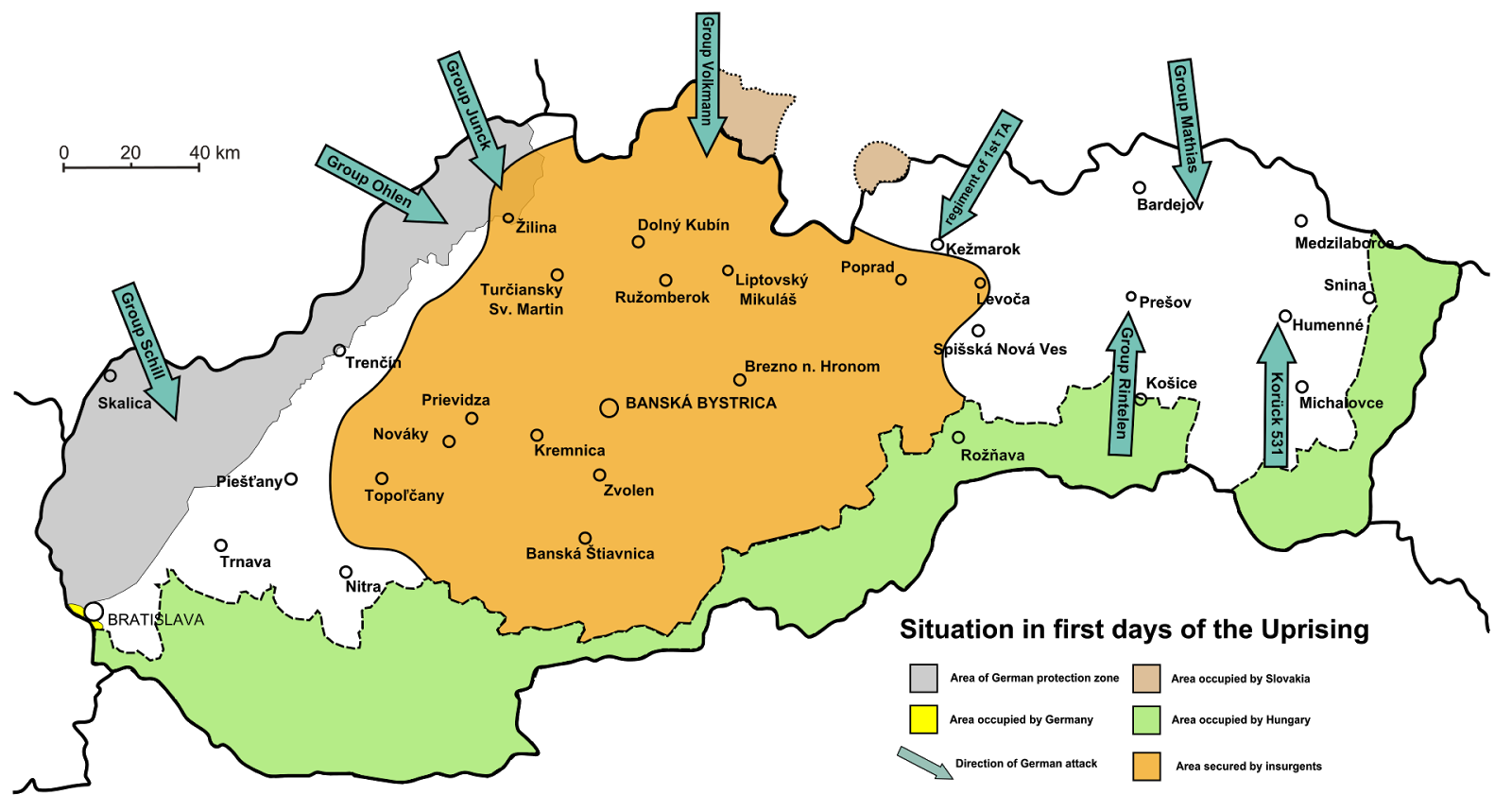
The Nazi puppet state in Slovakia sent small ground and air units to fight against the Soviet Union. Formerly a province of the Austro-Hungarian Empire, after World War I Slovakia shared the twists and turns of the history of the Czech state. But during World War II the two provinces were split when a Nazi protectorate was set up in Slovakia under a local priest and fascist leader, Josef Tiso (1887-1947). Slovakia adhered to the Tripartite Pact and Axis alliance on November 23, 1940. In June 1941, it declared war on the Soviet Union. There followed declarations of war against the Western Allies in tandem with the German declarations of December 11, 1941. The Slovak population did not so readily embrace these pro-German policies. At the end of August 1944, the Slovak Uprising broke out. 

SLOVAK UPRISING (1944)
Some in the fascist Slovak Army tried to play a clever game of rising against the Germans before the arrival of the Red Army, to assert a primary political claim for the postwar period. As with the Warsaw Uprising, the problem was fatal mistiming. On August 29, 1944, Slovak resistance fighters rose against the Germans, declaring "Free Slovakia" while hoping for help from the approaching Red Army. That same day, seven Soviet Fronts were ordered onto the "strict defensive" along the Eastern Front. Toward the end the VVS flew in supplies and some Czech and Slovak fighters to an isolated pocket of continuing resistance in north-central Slovakia. Czech pilots in the VVS flew air cover over the area and a Czech-Slovak brigade was parachuted in. Otherwise, the uprising in Slovakia was left to burn itself out. The last stronghold of the rebels was crushed on October 27. A few survivors made it into the Carpathians. Most were wiped out by the Wehrmacht and punitive Schutzstaffel (SS) and criminal brigades, the latter with hands still bloody from mass murders committed in Warsaw. Slovakia was not liberated by the Red Army until 1945.

Like the Warsaw Rising in Poland, the Slovak rebellion was savagely crushed by the Germans by the end of October: it was as hard for small powers to leave the Axis at the end of the war as it was to resist annexation at its beginning. Slovakia was defended against the assaulting Red Army by German 1st Panzer Army. That was a misnamed force without any tanks which had no chance against the combat power it faced in Soviet 1st and 4th Ukrainian Fronts. Three Soviet armies broke part way into the Carpathians in September-October during what Russian historians call the "East Carpathian operation." After a two-month pause, a complimentary "West Carpathian operation" was launched in January-February, 1945. It was temporarily blocked by a stiffened defense by 600,000 Axis troops led by General Ferdinand Schörner. Stalin and the Stavka sacked the original Soviet commander, replacing him with General Andrei Yeremenko. He also had trouble with Slovakia's terrain: mountain fighting was new to much of the Red Army, while in Slovakia the Soviets faced German and Waffen-SS bitterenders. Yeremenko was reinforced and attacked again from March to May, 1945. His “Bratislava-Brno operation “went around the German flanks and up the Danube valley. Bratislava fell on April 4. Brno was taken on the 28th. Tiso was found hiding in a cellar. He was hanged as a traitor in 1947. Prime Minister Winston Churchill urged the new American President, Harry Truman, to send American forces to take Prague. American 3rd and 7th Armies had advanced through Bavaria against light resistance and reached the border of western Bohemia on April 25, 1945. By Allied agreement, liberation of Prague was left to the Red Army. Citizens of the city had other ideas and rose on May 4, though perhaps more in celebration of expected liberation than in violent determination to liberate themselves. 

The rising cut off remnants of Army Group Center from escape to the west or back to Germany, so German troops tried to retake Prague. The Red Army arrived five days later, one day after a formal ceasefire and surrender agreement at Reims went into effect across Germany. The Soviets took down the last German resistance after a blistering artillery barrage. There was heavy fighting in other parts of Czechoslovakia by bitterenders in Army Group Center, especially among Waffen-SS units. More famously, there was some fighting with a demoralized division of the Russian Liberation Army that lasted until May 11. All that made Czechoslovakia the first territory invaded by German troops and the last from which they were violently expelled.

When the fighting ended, almost 720,000 Germans were marched off to Soviet POW camps. Most remained in harsh captivity for years, working as forced laborers in the Soviet Union. The Red Army put its losses for nine months of the Czech and Slovak campaigns at 140,000 men. When the Soviets withdrew their armed forces from the country, Benes returned as president of a restored Czechoslovakia. The dawn of liberation did not last long: in 1946 Benes appointed a Communist prime minister in yet another foolhardy placatory gesture toward Moscow. In February 1948, a Communist coup forced Benes to resign. Klement Gottwald, a harsh Stalinist, thereafter embedded Czechoslovakia deep inside an emerging postwar "Soviet bloc."